Other
Hot Delhi
₹80,000
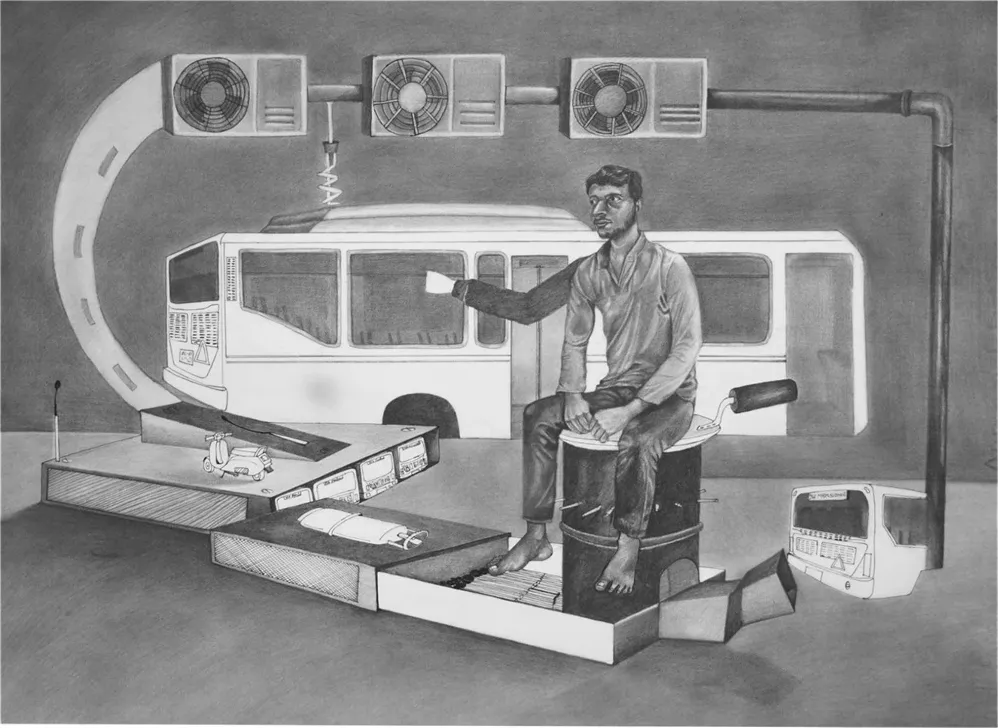
“Hot Delhi” is a surrealist portrayal of the suffocating reality of life in India’s capital, where extreme heat and pollution have become daily torment. At the center of the composition, a barefoot man sits atop a tandoor-like drum, his body partially fused with the structure of a DTC bus—transforming into a lifeless component of the very system meant to serve him. This haunting fusion captures the physical and psychological toll of surviving in an environment that feels more like an open oven than a city. Above him, industrial fans hang uselessly, symbolizing the failure of infrastructure to offer relief. The monochromatic graphite rendering adds to the emotional weight, evoking the bleakness of smog-filled air and a sky devoid of life. Through this deeply personal yet universal image, the artist critiques the environmental decay and systemic indifference that reduces human lives to machinery in the relentless grind of urban survival.
Interested in this piece?
Chat on WhatsAppOr reach us directly at +91 79824 33408
Home visit available
Select artworks can be viewed at your home before you decide. A visit is ₹1,000 per artwork, fully adjusted against the purchase if you go ahead. See how it works.
Ask about a home visit for this pieceOr leave us a question about this piece
- Category
- Drawing
- Subcategory
- Graphite on paper
- Year
- 2024
- Dimensions
- 22 × 30 in
- Place
- Delhi
- Certificate no.
- MS-"HotDelhi" -2024
Color palette
- Gray (87%)
- White (13%)
Exact tones detected
GrayGrayGrayGrayGray
Description
"Hot Delhi" encapsulates the suffocating intensity of the city’s record-breaking heat and toxic air, intertwining personal experience with surrealist imagery. The central figure—barefoot, expressionless, and seated on a tandoor-like drum—embodies the average commuter, enduring daily extremes. His body partially morphs into a paint roller, symbolizing how individuals are compelled to blend into and navigate their harsh environments.
Behind him stands a DTC bus, a vessel representing both survival and struggle. The air conditioner surrounding him, intended to provide relief, seem ineffective, illustrating the failure of technology to address environmental collapse. Scattered pollution devices and mechanical parts in the foreground resemble offerings to a broken system. The Delhi environment is depicted not merely as hot, but as an open oven where existence simmers silently.
this artwork is rooted in my lived experience—standing at the back of a DTC bus, feeling the scorching heat. This honesty infuses the piece with power: it transcends a mere painting to become a testimony.
The matchbox articulates that Delhi is at a breaking point, unable to withstand even a single spark of further chaos. Nearby, a gas cylinder symbolizes an imminent explosion, representing the volatile mix of environmental issues at play. The air conditioner is depicted as a traffic light signaling 'stop', emphasizing its dual role as both a contributor to pollution and a vital tool for relief.
The Tandoor seat reflects the oppressive heat that reduces human beings to mere commodities, akin to food endlessly cooking in a relentless environment. The barefoot man serves as a poignant reminder of the vulnerability and often-overlooked struggles of the working class. Fans symbolize the futile technological efforts to combat climate change, providing little more than temporary relief.
Elements of public transportation reveal the paradox of buses, which serve as both essential lifelines and constraining spaces that limit freedom. The paint roller arm captures the harsh reality of forced adaptation, where individuals are reduced to mere tools within a system, losing their humanity. Scattered machinery signifies disjointed infrastructures that fail to sustain life effectively. Conversely, the presence of air conditioning not only alleviates discomfort but also underscores its role in the ongoing battle against pollution, highlighting the complexities of modern urban living.
Technique Highlight
This piece uses graphite for a gritty, smoky texture that evokes Delhi’s dusty air. The strong contrast between smooth mechanical forms and the textured human figure shows precise control over shading and tonal range. The fine detailing in the bus, fans, and machine parts reflects a high level of technical rendering, with surreal transitions blending human and object.
Historical Context
Delhi has experienced severe heatwaves in recent years, breaking temperature records while grappling with extreme air pollution. Public transportation, like DTC buses, becomes a site of both refuge and suffering for working-class individuals. This artwork reflects the socio-environmental crisis and the growing disconnect between urban development and human well-being.
Color Analysis
While this drawing is rendered in monochrome graphite, the absence of color intensifies the emotional weight. The greyscale mirrors Delhi's smoggy skyline, evoking a sense of lifelessness and breathlessness. The lack of vibrant hues reflects the heat’s oppressive nature and the emotional dullness caused by prolonged exposure to such harsh conditions.
Symbolism
- Matchbox: Symbolizes Delhi's precarious state, unable to handle any additional chaos.
- Cylinder: Represents imminent danger from environmental issues, reflecting a volatile mix of factors.
- Air Conditioner: Dual nature as a 'stop' signal—contributing to pollution while also providing necessary relief from heat.Air Conditioning Highlights its complexity in urban living by alleviating discomfort while contributing to pollution challenges.
- Tandoor Seat: Illustrates oppressive heat that dehumanizes individuals, likening them to food cooking in an unrelenting environment.
- Barefoot Man: A poignant symbol of the vulnerability and struggles of the working class, often overlooked in society.
- Fans: Represent futile technological efforts to combat climate change, providing only temporary relief.
- Public Transportation Elements: Buses act as both essential lifelines and restrictive spaces, encapsulating a paradox of urban mobility.
- Paint Roller Arm: Embodies the harsh reality of forced adaptation, reducing individuals to mere tools within a system.
- Scattered Machinery: Illustrates disjointed infrastructures that struggle to support life effectively.
Technique
This piece uses graphite for a gritty, smoky texture that evokes Delhi’s dusty air. The strong contrast between smooth mechanical forms and the textured human figure shows precise control over shading and tonal range. The fine detailing in the bus, fans, and machine parts reflects a high level of technical rendering, with surreal transitions blending human and object.
Historical context
Delhi has experienced severe heatwaves in recent years, breaking temperature records while grappling with extreme air pollution. Public transportation, like DTC buses, becomes a site of both refuge and suffering for working-class individuals. This artwork reflects the socio-environmental crisis and the growing disconnect between urban development and human well-being.
Symbolism
The matchbox illustrates that Delhi is at a breaking point, unable to withstand even a single spark of further chaos. Beside it, the cylinder signifies an imminent explosion—representing the volatile mix of environmental issues. The air conditioner, depicted as a traffic light signaling 'stop', highlights its dual nature as both a contributor to pollution and a crucial tool for relief. The Tandoor seat symbolizes the oppressive heat that transforms human beings into mere commodities, akin to food left to cook endlessly in a relentless environment. The barefoot man stands as a poignant reminder of the vulnerability and often-overlooked struggles of the working class. Meanwhile, fans serve as symbols of futile technological efforts to mitigate the effects of climate change, offering little more than a temporary respite. Elements of public transportation reveal the paradox of buses, acting as both a crucial lifeline and a constraining space that limits freedom. The paint roller arm embodies the harsh reality of forced adaptation, where individuals become mere tools in a system rather than retaining their humanity. Scattered machinery represents disjointed infrastructures that struggle to sustain life effectively. Conversely, the presence of air conditioning not only serves to alleviate discomfort but also underscores its role in the ongoing battle against pollution, highlighting the complexities of modern urban living.
Catalogued May 8, 2025
From the same artist
More by Madhusudhan Sharma


Keep exploring