Society Of My Imagination
Eyes See, But Do Not Care
₹80,000
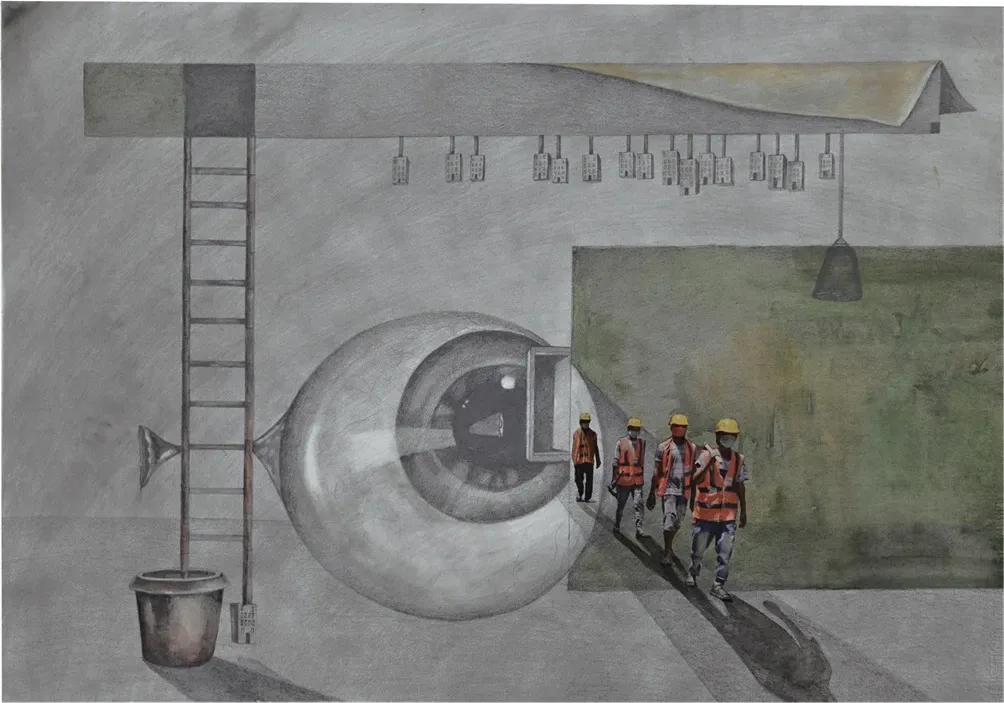
“Eyes See, But Do Not Care” explores the overlooked lives of labourers through a surrealist lens. A colossal eye symbolises a society that sees workers but fails to truly acknowledge their struggles. Workers emerge from the pupil in a uniform line, suggesting mechanised labour, loss of individuality, and a repetitive cycle of work. The movement from shadow into emptiness reflects a life where labour continues without rest or recognition.
Interested in this piece?
Chat on WhatsAppOr reach us directly at +91 79824 33408
Home visit available
Select artworks can be viewed at your home before you decide. A visit is ₹1,000 per artwork, fully adjusted against the purchase if you go ahead. See how it works.
Ask about a home visit for this pieceOr leave us a question about this piece
- Category
- Drawing
- Subcategory
- Graphite on paper
- Year
- 2024
- Dimensions
- 22 × 30 in
- Place
- Delhi
- Certificate no.
- MS-"Eyes See, But Do Not Care" -2024
Color palette
- Gray (92%)
- White (8%)
- Red (0%)
Exact tones detected
GrayGrayGrayGrayGray
Description
Eyes See, But Do Not Care, the artist, drawing from personal experience and the harsh realities of surrounding society, has decided to create a poignant artwork for labor life. Through a surrealist lens, the piece constructs a haunting narrative where human effort is mechanized and routine becomes prison. Central to the composition is a colossal eye, symbolizing constant surveillance—society sees the laborers but does not truly look at them. Marching out of the eye’s pupil, workers in safety gear walk in a uniform line, stripped of individuality, moving from shadow into a void that offers no promise of rest.
A metallic bucket below the ladder represents containment and the burden of unacknowledged labor, while the megaphone attached to the side of the eye goes silent—an unheard plea. Suspended miniature buildings dangle like currency or bait, representing urban development built on laborers’ backs, but never within their reach. This artwork confronts the emotional toll of unending labor and the alienation from one’s own family and desires.
The piece is not just an observation, but a declaration: “We build the world, yet have no place in it.” It immortalizes the invisible cost of progress with empathy and a quiet, defiant strength.
Technique Highlight:
This artwork is rendered in mixed media, combining graphite with selective watercolor to highlight the bleak monotony of labor. The subdued palette reinforces the mechanical repetition of daily life, while watercolor accents subtly hint at traces of humanity amid uniformity. Detailed shading, especially in the realistic depiction of the eye, demonstrates precise technical skill. Smooth tonal transitions and controlled textures create an atmosphere of quiet oppression, capturing the emotional weight carried by those whose lives are shaped by relentless, unseen labor.
Historical Context:
In many developing nations, laborers form the backbone of urban growth, yet their lives remain marginalized. This artwork taps into the post-industrial, post-colonial narrative where human beings are reduced to functional tools. It echoes themes seen in Diego Rivera’s murals and the works of George Tooker, reflecting alienation, surveillance, and urban entrapment.
Color Analysis:
Muted greys dominate the background, symbolizing monotony, suppression, and lifelessness. The only strong colors—orange safety vests and yellow helmets—highlight the laborers but also isolate them, making them appear as both present and excluded. The green wall in the background, dull and fading, suggests dreams deferred and a hope that never fully emerges.
Symbolism:
Eye: Constant observation; society sees but does not connect.
Ladder: Aspiration without destination; unreachable progress.
Bucket: The weight and limits placed on workers.
Megaphone: Silenced voices of laborers.
Hanging Buildings: Achievements built by labor, never owned by them.
Uniform March: Loss of individuality, mechanical repetition of life.
Technique
This artwork is rendered in mixed media, combining graphite with selective watercolor to highlight the bleak monotony of labor. The subdued palette reinforces the mechanical repetition of daily life, while watercolor accents subtly hint at traces of humanity amid uniformity. Detailed shading, especially in the realistic depiction of the eye, demonstrates precise technical skill. Smooth tonal transitions and controlled textures create an atmosphere of quiet oppression, capturing the emotional weight carried by those whose lives are shaped by relentless, unseen labor.
Historical context
In many developing nations, laborers form the backbone of urban growth, yet their lives remain marginalized. This artwork taps into the post-industrial, post-colonial narrative where human beings are reduced to functional tools. It echoes themes seen in Diego Rivera’s murals and the works of George Tooker, reflecting alienation, surveillance, and urban entrapment.
Symbolism
At the heart of this surreal composition lies a powerful array of symbols that expose the alienation and exploitation of laborers. The giant eye represents constant surveillance—society watches the workers but fails to truly acknowledge their humanity. Nearby, a ladder stretches upward, a false promise of progress that remains perpetually out of reach, symbolizing aspirations stunted by systemic barriers. The bucket below becomes a metaphor for the burdens and limitations imposed on these individuals, collecting toil without recognition. A megaphone, ironically silenced, speaks volumes about the unheard voices of the labor force—their struggles ignored despite their essential contributions. Above them hang miniature buildings, visual stand-ins for the infrastructure they construct but are never allowed to claim. Finally, the uniform march of the workers underscores a chilling loss of individuality, where daily life becomes mechanical and unchanging. Together, these elements form a deeply resonant commentary on invisible labor and systemic neglect.
Catalogued May 7, 2025
From the same artist
More by Madhusudhan Sharma


Keep exploring