

Bee in city life
Bee in City V
₹80,000
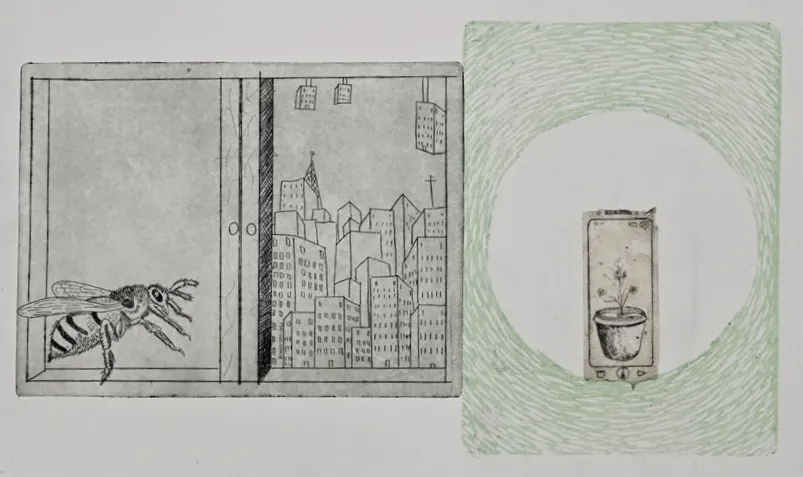
Bee in City is a surrealist drypoint and woodcut print exploring the conflict between nature and urbanisation. A lone bee hovers near a closed window, surrounded by concrete structures. A potted plant enclosed within a circular frame suggests nature trapped within the boundaries of an artificial environment. The work questions whether nature and biodiversity can survive as cities continue to expand.
Interested in this piece?
Chat on WhatsAppOr reach us directly at +91 79824 33408
Home visit available
Select artworks can be viewed at your home before you decide. A visit is ₹1,000 per artwork, fully adjusted against the purchase if you go ahead. See how it works.
Ask about a home visit for this pieceOr leave us a question about this piece
- Category
- Print Making
- Subcategory
- Woodcut,Drypoint
- Year
- 2024
- Dimensions
- 15 × 22 in
- Place
- Delhi
- Certificate no.
- MS-BEE-V-2024
Color palette
- Gray (92%)
- White (7%)
- Black (0%)
Exact tones detected
Light GrayLight GrayLight GrayLight GrayLight Gray
Description
Bee in City is a surrealist hybrid print combining drypoint etching and woodcut techniques to explore nature’s precarious place within the rigid order of urban life. The composition centers on a meticulously rendered bee—its delicate form hovering before a sealed window. Beyond the glass stretches an oppressive cityscape of repetitive geometric structures, their sterile symmetry evoking both confinement and artificiality.
To the right, encased within a prominent green circle carved with dynamic woodcut swirls, a digital screen displays a potted plant—an isolated fragment of nature mediated through technology. This juxtaposition raises a haunting question: as urbanization expands, are we replacing living ecosystems with pixelated simulations?
The bee, traditionally a symbol of pollination and natural harmony, appears displaced—its presence underscoring the absurdity of ecological systems strained by human infrastructure. Meanwhile, the digitized plant, confined within its circular frame, becomes a spectral echo of wilderness, suggesting a future where flora persists only as curated images rather than living entities.
Through its surreal, disjointed aesthetic, the piece compels viewers to confront the growing rift between organic life and constructed environments. The bee—once an essential thread in the web of ecology—now navigates a world that renders it obsolete, a poignant metaphor for nature’s fading voice in the age of concrete and code.
Technique Highlight
This work is a compelling combination of Drypoint and woodcut:
Drypoint enables delicate, expressive line work seen in the city structures and the bee. The burr created by the needle gives the bee a raw, almost buzzing texture.
Woodcut, used in the swirling green background, introduces a strong graphic rhythm, creating a tactile sense of chaos and void. This contrast between sharp etching and rough carving reinforces the duality of the real and artificial, nature and simulation.
Historical Context
This piece connects deeply with 21st-century concerns of environmental decay, pollinator extinction, and the digitization of experience. Bees, once common in daily life, are now endangered due to urban sprawl, pollution, and habitat loss. As cities grow, nature is compressed into controlled fragments—parks, pots, and pixels.
The work also echoes early Surrealist printmaking, particularly the likes of Max Ernst or Leonora Carrington, who used hybrid creatures and dislocated architecture to explore human-nature relationships. It’s both a tribute and a warning—rooted in contemporary ecological crises.
Color Analysis
The monochrome palette, punctuated only by faint green tones, evokes barren, with color deliberately restricted to the artificial depiction of nature—the glowing phone screen. Unlike the lush vibrancy of organic life, the green within the circle appears dull and synthetic, reinforcing its manufactured essence. Meanwhile, the stark interplay of black and white intensifies the visual tension, mirroring themes of disconnection and fragmentation. This sharp contrast becomes a metaphor for urban alienation, where nature exists only as a diminished, controlled spectacle within an austere, man-made world.
The overall monochrome palette with minimal green symbolizes sterility, with color reserved only for the artificial representation of nature (the phone screen).
The green circle is not vibrant but subdued, suggesting artificiality rather than vitality.
The stark black-and-white forms heighten the sense of contrast, loss, and fragmentation—hallmarks of urban alienation.
Symbolism
The Bee, once a vital symbol of natural order and harmony, now appears displaced and marginalized—an outsider in its own world. The Window and City loom as imposing barriers, embodying the relentless spread of urbanization that cages not just wildlife but humanity itself, severing ties to the organic rhythms of the earth. The Digital Plant, sterile and pixel-perfect, mirrors society’s troubling shift toward artificial substitutes—a testament to our growing preference for curated illusions over raw, living presence. Meanwhile, the Green Circle hovers like a fading memory, its stylized form rendering nature both decorative and distant, a hollow echo of what once thrived beyond concrete and glass. Together, these elements form a haunting meditation on erasure, illusion, and the price of "progress."
The Bee: A symbol of natural order, now displaced and marginalized.
The Window/City: Represents barriers and the spread of urban life that cages both humans and animals.
The Digital Plant: Symbolizes virtual replacement—our growing comfort with illusion over physical presence.
The Green Circle: A fading memory or illusion of nature, stylized and distant.
Technique
This work is a compelling combination of drypoint and woodcut: Drypoint enables delicate, expressive line work seen in the city structures and the bee. The burr created by the needle gives the bee a raw, almost buzzing texture. Woodcut, used in the swirling green background, introduces a strong graphic rhythm, creating a tactile sense of chaos and void. This contrast between sharp etching and rough carving reinforces the duality of the real and artificial, nature and simulation.
Historical context
This piece connects deeply with 21st-century concerns of environmental decay, pollinator extinction, and the digitization of experience. Bees, once common in daily life, are now endangered due to urban sprawl, pollution, and habitat loss. As cities grow, nature is compressed into controlled fragments—parks, pots, and pixels. The work also echoes early Surrealist printmaking, particularly the likes of Max Ernst or Leonora Carrington, who used hybrid creatures and dislocated architecture to explore human-nature relationships. It’s both a tribute and a warning—rooted in contemporary ecological crises.
Symbolism
The Bee, once a vital symbol of natural order and harmony, now appears displaced and marginalized—an outsider in its own world. The Window and City loom as imposing barriers, embodying the relentless spread of urbanization that cages not just wildlife but humanity itself, severing ties to the organic rhythms of the earth. The Digital Plant, sterile and pixel-perfect, mirrors society’s troubling shift toward artificial substitutes—a testament to our growing preference for curated illusions over raw, living presence. Meanwhile, the Green Circle hovers like a fading memory, its stylized form rendering nature both decorative and distant, a hollow echo of what once thrived beyond concrete and glass. Together, these elements form a haunting meditation on erasure, illusion, and the price of "progress."
Catalogued May 14, 2025
From the same artist
More by Madhusudhan Sharma


Keep exploring
Related artworks


