

Other
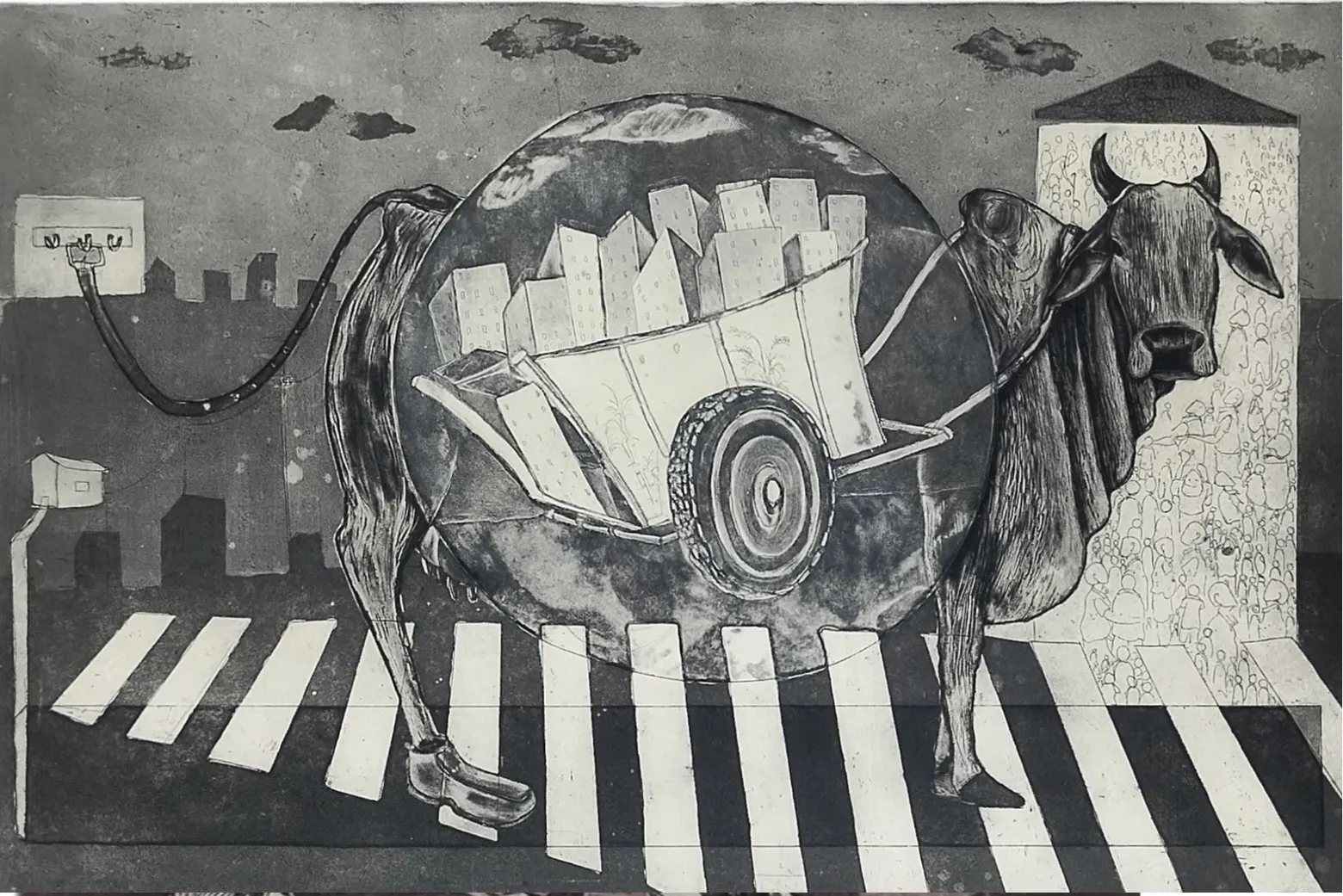
Cow in City VI
₹1,20,000
In this surreal etching, a cow fused with a wheelbarrow and urban buildings trudges across a crosswalk, symbolizing the burden of urbanization on nature and the silent exploitation of animals in the shadow of human progress.
Interested in this piece?
Chat on WhatsAppOr reach us directly at +91 79824 33408
Home visit available
Select artworks can be viewed at your home before you decide. A visit is ₹1,000 per artwork, fully adjusted against the purchase if you go ahead. See how it works.
Ask about a home visit for this pieceOr leave us a question about this piece
- Category
- Print Making
- Subcategory
- Etching
- Year
- 2024
- Dimensions
- 15 × 20 in
- Place
- Delhi
- Certificate no.
- MS-COW-VI-2024
Color palette
- Gray (91%)
- White (9%)
Exact tones detected
Dark GrayWhiteDark GrayDark GrayLight Gray
Description
This surreal etching powerfully critiques urban expansion and the exploitation of animals through the fusion of organic and mechanical forms. A cow, rendered in painstaking detail, occupies the central space—but its body is distorted and transformed into a wheelbarrow loaded with towering city buildings. The wheel of the cart becomes the cow's midsection, a visual metaphor for how animals are forced to carry the literal and symbolic weight of human development.
The cow's front leg wears a shoe, humanizing it and hinting at forced adaptation or domestication. It walks over a bold, graphic zebra crossing, a symbol of modern infrastructure, placing this surreal vision squarely in the contemporary urban setting. In the background, sketched crowds and city blocks add a sense of relentless population pressure and the mechanization of daily life.
A plugged-in cable connects to the cow’s tail, suggesting electricity or energy extraction, hinting at the deeper idea of how animals are not only physically burdened but also metaphorically “plugged in” to the systems of human survival. The skies are filled with clouds, possibly indicating industrial pollution or the looming consequences of unchecked urbanization.
At once absurd and poignant, the piece uses distortion and juxtaposition to provoke reflection on humanity’s parasitic relationship with animals and the environment. It exposes how nature is appropriated, reshaped, and repurposed to suit urban desires.
Technique Highlight
The artist uses etching with meticulous line work, especially visible in the textures of the cow’s skin, architectural forms, and mechanical elements. The contrast between precise etched textures (in the cow and buildings) and softer shading in the background enhances the surreal tension. Cross-hatching and tonal etching add depth, while the stark graphic pattern of the zebra crossing creates a grounding visual rhythm.
Historical Context
This work belongs to a contemporary surrealist lineage, influenced by classic surrealism's dreamlike distortions but directed toward ecological and socio-political commentary. In the context of India’s rapidly growing urban landscape, the cow becomes a highly charged symbol: traditionally sacred and protected, yet increasingly marginalized or abused amid modernization. The artwork reflects tensions between tradition, industrialization, and the exploitation of both labor and nature.
Color Analysis
- Monochrome palette: A deliberate grayscale choice evokes a documentary, archival tone—fitting for a critique of urban progress.
- High contrast areas (zebra crossing, architectural forms) juxtapose sharply with softer sky and background shading, guiding the eye from foreground to background and emphasizing the constructed/artificial versus organic/natural.
- Greyscale layering: Adds depth and emotional weight, suggesting the coldness of urban systems versus the organic suffering of the animal.
Symbolism
- Cow with Cart Body: Represents how animals (especially cows in India) are burdened with the load of human urban growth—literally carrying cities on their backs.
- Wheel: Symbol of industrialization and relentless motion; the fusion into the cow’s body shows unnatural integration of machinery into life.
- Shoe on Hoof: Suggests domestication, exploitation, and unnatural adaptation of animals for human utility.
- Zebra Crossing: Represents modernity and regulated movement, contrasting with the disoriented and overburdened creature.
- Plugged-in Tail: Symbolizes energy consumption, the commodification of animals, and forced assimilation into modern systems.
- Crowd and Cityscape: The overwhelming pressure of human expansion and anonymity—urbanization as a faceless, consuming force.
Technique
The artist uses etching with meticulous line work, especially visible in the textures of the cow’s skin, architectural forms, and mechanical elements. The contrast between precise etched textures (in the cow and buildings) and softer shading in the background enhances the surreal tension. Cross-hatching and tonal etching add depth, while the stark graphic pattern of the zebra crossing creates a grounding visual rhythm.
Historical context
This work belongs to a contemporary surrealist lineage, influenced by classic surrealism's dreamlike distortions but directed toward ecological and socio-political commentary. In the context of India’s rapidly growing urban landscape, the cow becomes a highly charged symbol: traditionally sacred and protected, yet increasingly marginalized or abused amid modernization. The artwork reflects tensions between tradition, industrialization, and the exploitation of both labor and nature.
Symbolism
The cow with a cart for a body becomes a visceral metaphor for how animals—particularly in India—are crushed under the weight of urban progress, forced to bear the literal and symbolic load of human expansion. The wheel, fused grotesquely into its flesh, embodies industrialization’s relentless march, turning living beings into cogs within an unnatural machine. A shoe strapped to its hoof underscores the harsh domestication and distortion of nature for utility, rendering the animal’s innate form obsolete. Beneath it, the zebra crossing—a symbol of order and modernity—lies in stark contrast to the creature’s disoriented struggle, highlighting the dissonance between regulated urban life and the suffering it imposes on the voiceless. Meanwhile, the tail, plugged into an unseen system, suggests energy extraction and commodification, as if even the creature’s vitality is harnessed for an impersonal grid. Surrounding it, the crowd and towering cityscape loom as an anonymous, consuming force—urbanization not as progress, but as an all-devouring engine, erasing individuality and perpetuating exploitation. Together, the image becomes a haunting critique of development built on the backs of the powerless, where tradition, nature, and autonomy are sacrificed to feed an insatiable machine.
Catalogued May 2, 2025
From the same artist
More by Madhusudhan Sharma


Keep exploring
Related artworks


