

Voice of Voiceless
Voice of Voiceless
₹2,00,000
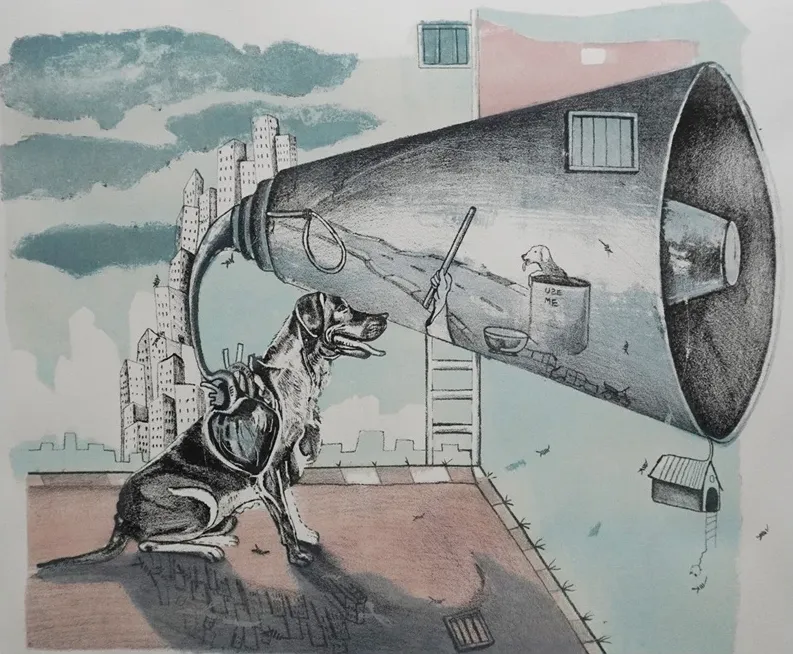
In this surrealist lithograph titled "Voice of Voiceless", a dog sits atop a rooftop, connected to a megaphone by a human heart, symbolically amplifying its silent plea. The artwork critiques society’s treatment of animals in urban environments, combining dreamlike elements and symbolism to evoke empathy and awareness.
Interested in this piece?
Chat on WhatsAppOr reach us directly at +91 79824 33408
Home visit available
Select artworks can be viewed at your home before you decide. A visit is ₹1,000 per artwork, fully adjusted against the purchase if you go ahead. See how it works.
Ask about a home visit for this pieceOr leave us a question about this piece
- Category
- Print Making
- Subcategory
- Lithography
- Year
- 2023
- Dimensions
- 23 × 25 in
- Place
- Delhi
- Certificate no.
- MS-DOG-2023
Color palette
- Gray (90%)
- White (8%)
- Black (2%)
Exact tones detected
Light GrayLight GrayLight GrayGrayWhite
Description
Voice of Voiceless is a surrealist lithographic artwork that poignantly captures the silent suffering of animals—particularly urban stray dogs—through metaphor and symbolism. At the center of the composition, a dog sits obediently on a city rooftop, its body connected to a megaphone by an anatomical human heart. Emerging from the megaphone’s mouth is a ghostly hand holding a stick, threatening a dog trapped inside a dustbin labeled “USE ME” a powerful commentary on how animals are discarded, abused, and treated as utilitarian objects.
The background is filled with clustered high-rise buildings, alluding to urbanization and human encroachment, while the sky is painted in a dreamy wash of pastel blue and muted pink, evoking an eerie calm amidst the chaos. Floating elements like a hanging doghouse and abstract architectural fragments enhance the surreal atmosphere.
The heart symbolizes empathy, suggesting that only through human compassion can animals' unheard voices be amplified. The megaphone becomes both a symbol of advocacy and a twisted tool of cruelty, reflecting the paradox of human intervention able to protect or harm. Through this visually arresting juxtaposition, the artist urges viewers to reflect on their ethical responsibilities toward animals and challenges the urban narrative of neglect.
Technique Highlight
This artwork is executed in lithography, a printmaking process where the artist draws directly onto a stone or metal plate with a greasy substance, which is then chemically treated so that ink adheres only to the drawn areas. The medium allows for rich tonal variation and precise detailing, evident in the meticulous rendering of the dog's fur, the heart’s anatomy, and the stark contrast in the megaphone’s interior. Lithography also enhances the surreal layering of imagery, as seen in the dreamy skyline and textural ground plane
Historical Context
Surrealism emerged in the early 20th century, spearheaded by artists like Salvador Dalí and René Magritte. It sought to unlock the unconscious mind and depict dreamlike scenes that defy logic, often with strong socio-political undertones. This artwork aligns with contemporary surrealism by using irrational juxtapositions and symbolic elements to highlight the neglect and abuse of stray animals a modern social issue particularly relevant in densely populated urban settings like Delhi. The theme resonates with the global discourse on animal rights and the ethical impact of urban expansion.
Color Analysis
The color palette is subtle yet emotionally potent, dominated by muted blues, greys, and dusty pinks. These tones create a calm but melancholic atmosphere, echoing the silence and helplessness of the dog. The subdued colors contrast with the raw red tones of the exposed heart and the dog’s naturalistic browns, drawing immediate focus to the emotional core of the composition. The use of cold and warm tones side by side enhances the tension between apathy and empathy.
Symbolism
- Dog: Represents the voiceless, often overlooked victims of urban cruelty.
- Human Heart: A symbol of empathy and the emotional bridge between humans and animals.
- Megaphone: Serves as both an amplifier of unheard cries and a weapon of control, suggesting duality in human roles—savior and abuser.
- Stick and Trash Can: Depict mistreatment and dehumanization, portraying how animals are beaten and discarded like waste.
- Hanging Doghouse: Suggests abandonment and lack of safe shelter.
- Cityscape: A metaphor for industrialization and the isolation of animals within urban development.
Technique
This artwork is executed in lithography, a printmaking process where the artist draws directly onto a stone or metal plate with a greasy substance, which is then chemically treated so that ink adheres only to the drawn areas. The medium allows for rich tonal variation and precise detailing, evident in the meticulous rendering of the dog's fur, the heart’s anatomy, and the stark contrast in the megaphone’s interior. Lithography also enhances the surreal layering of imagery, as seen in the dreamy skyline and textural ground plane
Historical context
Surrealism emerged in the early 20th century, spearheaded by artists like Salvador Dalí and René Magritte. It sought to unlock the unconscious mind and depict dreamlike scenes that defy logic, often with strong socio-political undertones. This artwork aligns with contemporary surrealism by using irrational juxtapositions and symbolic elements to highlight the neglect and abuse of stray animals—a modern social issue particularly relevant in densely populated urban settings like Delhi. The theme resonates with the global discourse on animal rights and the ethical impact of urban expansion.
Symbolism
Dog: Represents the voiceless, often overlooked victims of urban cruelty. Human Heart: A symbol of empathy and the emotional bridge between humans and animals. Megaphone: Serves as both an amplifier of unheard cries and a weapon of control, suggesting duality in human roles—savior and abuser. Stick and Trash Can: Depict mistreatment and dehumanization, portraying how animals are beaten and discarded like waste. Hanging Doghouse: Suggests abandonment and lack of safe shelter. Cityscape: A metaphor for industrialization and the isolation of animals within urban development.
Catalogued May 1, 2025
From the same artist
More by Madhusudhan Sharma


Keep exploring
Related artworks


